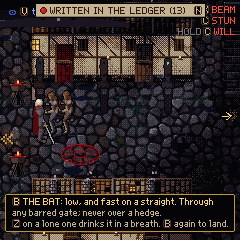
The city is built the way it thinks. The poor live by the river, outside the wall, where the water runs past the vats and the washing steps. Each great house sits on a ring of the hill above them, and the higher the ring, the greater the house. At the summit, the crown. Nothing in this place is level, and nobody in it is equal.
The hill, from the bottom up
| Where | What stands there |
|---|---|
| The gutter, by the river, outside the wall | the chandlery and its vats, the gang’s cellar, the river steps where the washerwomen work, the market cross and the pillory, the council house, the gutter church with its rose window, the orphanage, the bell tower, the South Bridge, the docks |
| The lowest ring | the spur of the Tower, its garrison village, its gibbets |
| The second ring | the quarry face and the Builders’ Guild |
| The first ring | the cistern and the counting house, the exchange |
| The summit | the crown: the Hundred Steps, the North Gate, the King’s hall |
| Out in the marsh | the convent of the High Priestess on its holm across the river, and the villages that do not speak |
| Between the churchyard and the city | the graveyard court: a city of the dead under a belfry, each door a coat of arms |
| Outside the court’s gate | the King’s Labyrinth Gardens, the Pleasance, and the road up to a shrine on the Height |
Streets of the dead, and every door a coat of arms.
The rich rot here in marble. I rose from mud.
The gutter
The gutter is the game’s home ground and the place it keeps coming back to. It is where Wick was a boy, where the gang named him, where the washerwomen still beat linen on the river steps. One of them looks at him too long. The gutter is also where the city keeps its accounts in public: the pillory stands in the square, the council meets in its house, and the church posts its calendar on the door.
The gutter remembers what Wick does in it. Feed on its people and that ward’s lantern gutters, the washerwomen’s talk turns to fear, the watch doubles its patrols, and fewer people come to the church on the great feast. Its children he never touches, and his mother he cannot feed on at all: the prompt does not appear on her.
The haven: the cathedral under the cathedral
The church built its public cathedral on top of an older one. Down there, under the churchyard, there is a drowned nave with seven niches and seven channels, a waterfall of blood, bone chandeliers, bats, and a throne set on the altar. Wick’s unmarked grave, dug outside the family fence, is a shaft straight down into it. He thinks he has found a palace.
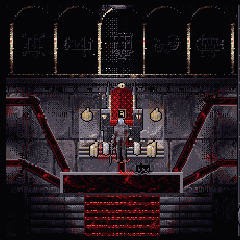
Your hall, beneath their cathedral. Every river in it is a village, bled.
The haven is the game’s sanctuary. Resting on the throne saves and restores him. Every church crypt in the city is a sealed door down to the haven’s catacombs, and once opened, each one is a checkpoint and a way home. A visitors’ stair comes down the east bay, and after each house the priest who bought Wick comes down it with one question and one gift, and sits in a chair by the stair.
The channels are the tithe. For centuries the villages’ blood has run down from every house into this hall. When a head is killed, that house’s river thins. When a head is spared, it runs dry. On the merciful path the city’s council sends down one channel of its own, so a sparing Wick is never starved. At the end, only what he took himself still flows.
Sealed · Mid-gameWhy the channels enter under carvingsBreak the seal to read
Each channel enters the haven under its house’s seal, cut into the floor. The hall is a key to the houses’ secret grammar, and the player lives in it. Stand by a channel and an aside names the house it comes from. The seventh channel runs out from under the throne itself: the priest’s own tithe feeds the seat directly. The haven was furnished, long before Wick was born, for the one who would come and sit in it.
The church, and what lies under it
The church in this game is sincere. The villages believe in it, the Bishop believes in it, and the saints are real saints to the people who pray to them. It is an invented church, built from familiar things: a rose window of founder-saints, feast days, processions, Latin hymns, an orphanage run as charity, townsfolk who say “the devil” for whatever is below.
Two rules help you read it.
- Small cross, big cross. A small cross over a cot, on a chest or in a hand is devotion. A big cross in the square, on the hill or in a rite chamber is the rite. Scale tells you intent.
- Warmth is not safety. The well-lit study is as dangerous as the darkest crypt. Nobody here is shifty. The clergy and the heads are calm, helpful and sincere, and that is the horror.
Seven lights. The men who founded the houses, made saints. Watch the glass. It will change.
Sealed · Mid-gameThe three layersBreak the seal to read
The church has three layers, and the game shows all of them in plain sight.
| Layer | What you see | What it is |
|---|---|---|
| The surface | a church, a bishop, saints, feasts, an orphanage | sincere, and believed |
| The belief | processions whose routes trace a figure on the hill, punched dots in the saints’ halos, arms built on seals, conjurations sung as hymns, every rite chamber a circle and a triangle in iron | the six houses’ real religion, an old book of spirits performed openly as liturgy. Nothing is hidden. It is unread. |
| Beneath | the rivers of tithe, the shaft under the grave, the stone in every triangle, a voice | older than the church and the houses, and the thing the whole apparatus feeds |
Each house keeps a patron from that old book, and the patron’s seal is the house’s secret arms: Halphas for the Tower, Focalor for the Empress, Shax for the High Priestess, Malphas for the Magician, Vassago for the Wheel, Zagan for the Sun, Furcas for the World. Whether any of them exists apart from the seats they name is never answered.
The seals are carved and inlaid in the world in iron grey, never red, never glowing. Once you know to look, you will find them under the paint of every shrine.
The season
The city is in a season of feasts, and knows it. The church year printed for it is called Fencetide: it opens with an offering buried outside a family’s fence and closes with the feast of the Blessed Hand. The calendar is posted on the gutter church’s door. A carpenter is building a scaffold in the square for a processional figure nobody will explain. The chandler’s cart carries six candles for a grave and one for a saint. The children skip to a rhyme that counts candles.
Nobody hides any of it. Nobody reads it. The game asks you to.
Stand at the gutter church’s door and read the calendar the first time you pass. Then read it again after the first house falls. The book of clues for this season is Chapter V.
The counters
There is no clock. The state of the world is shown by things you can see, always:
- The candles
- six, at his grave, on the orphanage’s rack and along the top of the status panel. Lit: a house stands.
- The rose window
- seven lights in the gutter church. Watch what each fall does to them.
- The pillory
- a stand for each house in the market square. The ruined sit in it, alive.
- The effigy
- a figure growing in the square, one piece for each house fallen.
In the panel, a house killed by the blow turns its candle to gold wax with a still flame and a halo. A spared house’s candle goes out in a thread of smoke. A ruined house’s hangs upside down, a dead wick.
The six houses
Six houses rule the hill. Each is an office as much as a family: each takes one thing from the villages below, and each keeps its grip with a public ceremony everybody attends and nobody questions. The game calls these ceremonies the mask.
| House | Its head | What it takes | Its mask | Its feast in the calendar |
|---|---|---|---|---|
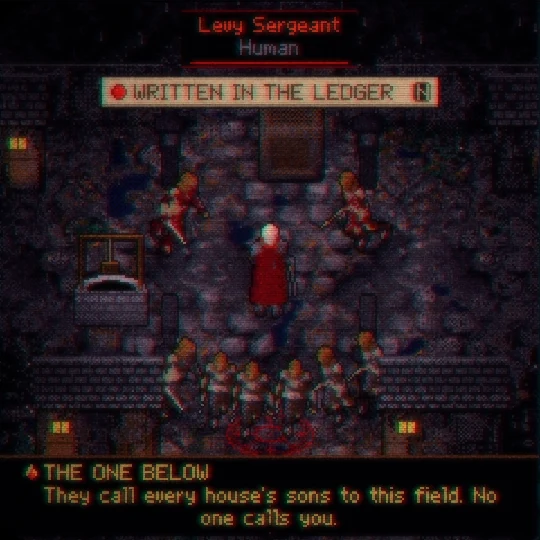
| The Tower | the Earl Marshal | the sons: the levy, and the gibbets for the rest | the muster | The Soldier’s Feast |
| The Empress | the Duchess of Marrowmere | the infants: the foundling wheel and the roll | the foundling procession | The Mother’s Feast |
| The High Priestess | the Marchioness Shaxby | the voices: a marsh that says nothing | silent vespers | The Hush |
| The Magician | the Lord President of the Builders’ Guild | the men: the labour levy, buried in the quarry | the foundation stone | The Foundation |
| The Wheel | the Prince of Coin | the years: debt, sold and resold | the odds board hung | The Odds |
| The Sun | the King | the bread: the crown eats the fields | the feast | The Feast |
The Tower
The Earl Marshal’s keep stands on its spur in a storm that never quite breaks. His levy marches the village’s sons up seven hairpin turns to a beacon; his gibbets hold the rest. His household believes in the war and the law. His heir believes the night’s vigil is holy. The Earl believes something else, and has had his armour polished for it.
The Wheel
The Prince of Coin keeps the odds as his office. His exchange sells the villages’ years as paper; his travelling circus, the Grand Turn, follows every funeral to sell the freed their first debt; his works at the acid falls etch the plates the paper is printed from. Every act in his circus is paying off a debt. His board on the exchange wall carries one wager no one will take.
The Empress
The Duchess of Marrowmere is the mother of every foundling in the city. Each year the infants are carried up the Foundling Stair and turned in at the wheel of her ward house. Her land is Marrowmere, up in the hills, where every cup of the city’s water comes over a single lip into a great fall, and she owns the lip. She bought Wick his title.
The Sun
The King does not wait to be visited. When three houses have fallen he sends a herald down to the gutter to invite the dead lord to his table, and every door on the hill opens for the climb. His feast is laid in a triangle. The guest’s chair is at its base.
The High Priestess
The Marchioness Shaxby is abbess of the convent of the veil, out in the marsh. Her house takes the marsh’s voices: for thirty years the villages have not said aloud what the coach takes from them. Her bell rings two strokes and a rest.
The Magician
The Lord President of the Builders’ Guild built half the city and marked every stone of it. His quarry buries the men of the labour levy. His own house is a machine that moves on a schedule. His plans lie open on his drafting table, and he does not seem to mind who reads them.
Sealed · The endingThe seventh houseBreak the seal to read
There is a seventh. The calendar’s last feast is the Feast of the Blessed Hand, “kept when the six are kept”, and its house is the World: the orphanage, and the seat under it, and the priest who keeps both. Father Fulcran takes no grip of his own and wears no mask. He runs the whole apparatus. His patron in the old book is Furcas, the knight, a cruel old man on a pale horse who teaches logic and rhetoric, and the last room of the game is his.
The many hands
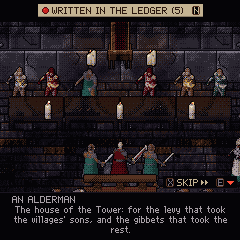
When a head is spared, the city’s council tries them. It is a council of guild masters, a watch captain, aldermen, a ferryman and the washerwomen’s ward, and it meets around an empty chair. The first trial you cause is a full scene; later ones are stills. Each verdict dissolves the house’s grip by decree and lights that ward’s council lamps.
The council is not good. It is next.
Two laws of the land
Nothing of Wick’s crosses running water: not his feet, not his beam, not his thread, in no form. Still water he can wade, slowly. The exceptions are a bridge someone built, the slack or flood of a tide, and a boat poled by a living hand. Learn it once; every place uses it.
People speak of tonight and of last month, because people do. The game keeps no clock and sets no deadline. The world changes when Wick does something, and only then. The moonlight is a look, never a rule.
Beyond the walls
| Place | What it is |
|---|---|
| The King’s Labyrinth Gardens | the crown’s hedge maze outside the wall, clipped at night by gardeners nobody counts |
| The Pleasance | a formal garden of parterres and a great fountain, with six statues of the founders and a seventh plinth, bare and swept. A man with a lantern lives in its grotto |
| The Height | a pilgrimage shrine on a mountain, where a giant monk carries a gilded cage up and down the stair |
| The Greenwood | the King’s Chase: the one sunlit place in the land, where outlaws rob the tithe carts on the King’s road |
| Marrowmere Falls | the Duchess’s water: terraces of pools, a great fall, a font behind it, a still mere above |
| The Assayer’s works | the acid falls, where debtors work off their years at the vats |
| The Wastes | the land the grip leaves behind: the Gallows Downs, the Spoil, the Tithe Fields, the Salt, the Wash |
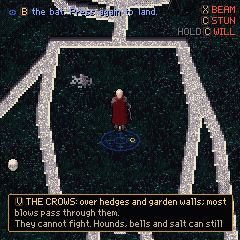
The Wastes are myth where the city is ordinary. In the city the horror is people doing what they are told; out there it is the grip made into landscape. Roads paved with ground-up heraldry. An orchard grown from hanged debtors. A cathedral gone to salt. A drowned fair that rises from the sea whenever a house falls. They open late, after the guided road, and they are covered in Walkthrough 8.