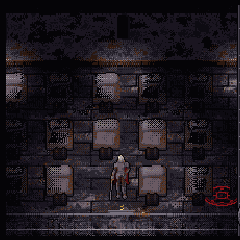
Væ Victis keeps two promises. A stranger can follow its surface story without trying. An attentive player can solve what is under it before the end, from the evidence alone, because every conclusion in the mystery can be reached three different ways. Miss a clue and you lose the chance to solve it early, never the ability to follow it. And at the end, the game shows you where every clue was.
This chapter is the reading list. The top layer tells you where to look and what to notice. The seals tell you what it means.
- The public claim against the written record. Whenever someone says one thing aloud, look for the document that says another.
- Nothing hidden, nothing read. The houses perform their real religion in front of everyone. Nobody reads it. Wick will not.
- Gated on houses, not on clues. The solution waits on how far you have come, never on whether you found everything.
The reading list
The scroll
Where: the opening of the game. What it is: the Life of the Blessed Hand, a roll of vellum drawn in iron-gall ink and red rubrics, showing a man’s life panel by panel as if it were a dead saint’s, with the voice below reading it to Wick over his body.
Notice: whose life it is. When it was made. Who would commission a saint’s life for a gutter boy.
- Ubi puer Wick in cloaca dormit: where the boy Wick slept in the gutter.
- Hic sacerdos eum emit: here the priest bought him.
- Hic ducissa eum dominum facit: here the duchess makes him a lord.
- Et ianuae clausae sunt: and the doors were shut.
- Hic occidunt eum: here they kill him.
- Et sepeliunt eum extra saepem: and they bury him outside the fence.
- Hic iacet in tenebris: here he lies in the dark.
- Ecce sedes quam ei paraverunt: behold the seat they made ready for him.
The design allows further panels to be added to the scroll: the saint’s future, two bare panels, a strip of six kneeling donors. Whether they are added is not yet decided TBD.
The calendar on the church door
Where: the gutter church’s west wall, beside the door. Stand at it to read it. What it is: the church’s printed year for the season: six feasts, each with its prayer and its procession, and then the feast of the Blessed Hand. Bound behind it is last season’s sheet from the same block.
The sheet is printed from a cracked woodblock under the head THE KALENDAR OF FENCETIDE, “the feasts of the season, set down by order of the church”. Its six feasts, as the game prints them:
| Feast | When | For | Its collect | |
|---|---|---|---|---|
| I | THE SOLDIER’S FEAST | 1st Sunday | of S. the Earl Marshal, martyr | the seven turns, well to beacon. The beacon put out. |
| II | THE MOTHER’S FEAST | 2nd Sunday | of S. the Duchess of Marrowmere, martyr | infants up the stair to the wheel. The pelican feeds. |
| III | THE HUSH | 3rd Sunday | of S. the Marchioness Shaxby, martyr | a day of no word. Two strokes and a rest. Coach east. |
| IV | THE FOUNDATION | 4th Sunday | of S. the Lord President of the Builders, martyr | a stone marked at every new house, by the guild. |
| V | THE ODDS | 5th Sunday | of S. the Prince of Coin, martyr | the board in the exchange: past above, to come below. |
| VI | THE FEAST | 6th Sunday | of S. the King, martyr | tables in a triangle: King at the apex, guest at base. |
Notice: the feasts are for saints who are not dead yet. Read each collect again after you have been to that house. Look at last season’s page.
Feasts. The church eats well in a hard year.
Bound behind it, the last season’s sheet from the same block: every feast struck through, and the Blessed Hand’s crossed out.
The candle-mould
Where: on the chandler’s bench in the chandlery yard, where Wick slept as a boy. What it is: a long block with seven mouths. Six are pale with tallow, a wick set in each. The last is dark.
Notice: count. Then count the candles at his grave.
The scaffold in the square
Where: the market square, by the church. What it is: a carpenter building a frame for a processional figure. It grows a piece for every house that falls.
For the Hand. They’ve had the timber cut since the frost.
Notice: when the timber was cut. What the figure is for. Whose face goes on it last.
The wall of offerings
Where: the orphanage refectory, on the way to the Father’s study. What it is: “the Father’s boys who went up”: a row of eight framed foundlings in lords’ coats, the oldest darkest. One frame has been scraped blank. One hook is empty. Wick, in red, hangs highest.
They hung me among them. Higher than the rest.
Notice: he looks only at his own. You should look at the others, and at the plaques beneath them.
The scratches
Where: the orphanage chapel, over the candle rack. What it is: the church’s image of the Blessed Hand, with scratches in its border that nobody has repaired.
The devil scratched the saint over the candles, and the Father would not have it mended.
Notice: damage to a holy thing that is honoured instead of mended. Who could have come back to this orphanage to scratch it.
Whether the chapel’s object is drawn as an icon or as a copy of the opening scroll is not yet settled in the design TBD. Either way, the scratches are the same.
The slate board
Where: the orphanage schoolroom, where Sister Ide teaches. What it is: a lesson in numbered heads, the last one rubbed out.
The design calls for “the seven liberal arts”, seven numbered heads with the seventh rubbed out. The board in the current build still shows “the five parts of an oration” TBD.
The bounty bill and the bill of sale
Where: the bounty bill is posted in the gutter and Snuff carries the story; the bill of sale is in the gang master’s box in the cellar. What they are: a reward for the thing in the belfry, a lord of no family, paid by the Vault Wardens; and the receipt for a baby.
A bill of sale in the gang master’s box: one male infant, off the coach, from the Coachman. A shilling and a bottle.
Notice: the bill names the seller and the price. It does not name the buyer. Somebody else wrote that down.
The rose window and the seventh plinth
Where: the gutter church’s rose window, and the Walk of the Founders in the King’s Pleasance. What they are: seven lights in the window, six founders’ faces and one of clear glass. Six statues of the founders on the walk, and a seventh plinth, bare and swept.
Six founders in stone. The seventh plinth is bare, and someone sweeps it.
Notice: the clear light never changes, whatever happens to the others. Somebody keeps a place for someone.
The stones on the hill
Where: the Ring of the Kneelers on the hill’s west shoulder, reached from the Gallows Downs. Before the end it is scenery. What it is: six stones kneeling inward, each with a cresset that burns while its house stands, and in the seventh place an uncut stone, upright and blank.
Stones, on their knees. All but one. That one I like.
The ledger
Where: in Wick’s coat, from the first priest’s visit on. What it is: the charity’s accounts, handed over with a request to keep them safe. Wick never opens it. The game shows you its pages as stills.
You carry it. You have not read it.
Sealed · Mid-gameWhat is in the ledgerBreak the seal to read
The pages the game shows you:
- Humiliations, dated years ahead, each one marked Paid. The doors that would be shut on him were booked before he was old enough to knock.
- An entry for a grave. Item: to the digger, for a grave outside the fence. Paid in advance.
- The arms page. Each house’s coat of arms beside its seal. With it, the punched dots in the saints’ halos, the routes of the processions, the heraldry and the seating of a feast all become readable.
- The rite-book page, under the heading Of the one who comes: Unhoused. Raised. Owed. Unled. Unheard. Unfed. And a seventh line, left blank. No name on any of it.
- His mother’s village: Sallowhithe, in the marsh.
The arms page is one of three ways to the seal key. The other two are the haven’s floor, where each channel enters under its house’s seal and an aside names the house, and the shrines of the fallen houses, where freed villagers chisel off the arms and bare the seal underneath before the church paints a saint’s face over it.
Sealed · Mid-gameThe formulaBreak the seal to read
Every head who dies by Wick’s hand thanks him, and every thanks ends on the same three words: manu quam laesimus, “by the hand we wronged”. It is sung at every rite and printed at the foot of the calendar. A clerk of the council notices it once, reading the first decree into the record. Nobody else in the game remarks on it. You should.
Sealed · The endingThe six conclusions, and their three routes eachBreak the seal to read
There is one fixed truth: the houses engineered their own apparent ruin. They wanted it all along. It breaks into six conclusions, and each has three independent routes and one contradiction, a public claim set against the written record.
| Conclusion | Route 1 | Route 2 | Route 3 | The claim against the record |
|---|---|---|---|---|
| They chose him | his saint’s life, commissioned before his death | the still of the night they chose him, and the robes cut to his measure | the ledger’s dated humiliations, Paid | the Bishop’s “the Blessed Hand came to us unbidden” against the calendar printed before |
| They want to die by his hand | the grave: “They will kneel to you and ask for the blow,” cut off | the still of the Earl’s last evening: “He is waiting for you.” | the askings and the thanks, the same words every time; the gap left in every rite | the Earl’s “Finish it as one soldier to another” against Paid |
| It has happened before | Andrevel: “You are not the first,” and his signet | the wall of offerings: eight frames, one scraped, one empty hook | the calendar’s struck page, the mould’s seventh mouth, the children’s rhyme | the gutter’s “nobody knows what turned him” against the knight’s “he went to the salt church to confess” |
| The god was the first offering | the burn line over the grave, “Six candles, one for each house that buried you.” (the design continues it with “I know this grave. The first one was mine.” TBD: not yet in the build) | the clear seventh light, never leaded | the confession, earned by failure; the last room, on the critical path | the church’s “the founder whose name was lost” against “They call me the Stone.” |
| The old book is the church’s grammar | the seals under the haven’s channels | the ledger’s arms page | the bared seals under the chiselled arms; the halo dots; the procession routes | the Bishop’s holy founders against the seal under the paint |
| His power is their harvest | “A gift from below. You did not ask for them.” | the rivers thinning with every kill, the offerings flowing uphill to the saints | the Salt Widow: “Don’t let them die of you.” | Wick’s “I rose” against “I took you out of it.” |
The rounds of the season are counted, never numbered aloud: in the wall’s eight frames, the calendar’s struck pages, the mould’s seven mouths, the rhyme, the marginal notes in the Cutting’s chalk, and the window’s seven lights. “Ninety years”, “forty-odd years” and “a generation”, from three different mouths, give the town its depth without a date.
Sealed · The endingThe seven marksBreak the seal to read
The rite-book’s page lists the marks of the one who comes. Each written mark belongs to one house and is read when that house falls. The seventh is the World’s, and the god’s.
| Mark | In the rite-book | What it means | |
|---|---|---|---|
| I | Unhoused | of no house: no blood of the six in him | the door he opens is no house’s own |
| II | Raised | raised by a house’s hand to a lord’s name | a man with nothing cannot be wronged; he must be lifted so he can be shut out. (It also means raised from the grave. Both were done to him.) |
| III | Owed | owed a wrong by every seat he takes | each head must have turned him from a door |
| IV | Unled | come to each circle with no hand upon him | no one may lead him: the priest asks, never bids, and the friend at his back is removed |
| V | Unheard | wronged where no court would hear it | a wrong a court had righted would be paid already |
| VI | Unfed | set at no table: no bread of the six in him | he must come hungry |
| VII | Unbowed | (the line is blank) | he kneels to no hand, not even to be spared |
Unhoused, Unheard and Unfed the orphanage makes by the dozen. Raised and Unled the houses can arrange. The one thing they could not make and had to find is a boy who kneels to no one. Every other mark was done to him; this one he believes is his own, and it is the one they shopped for.
At the end, in the last room, the priest reads the six written marks aloud and stops at the blank line. Wick says the seventh himself.
And unbowed.
He writes the last line with his own mouth, and hears it. The mark holds. The choice is what an unbowed man does with a seat.
Sealed · The endingThe receiptBreak the seal to read
In the last rooms, as each mark is said, the game shows you a still of where its clue was: the calendar on the door, the arms page, the wall of offerings, the mould, the scratches (legible at last), the six kneeling donors. It is the proof that the game played fair.
Andrevel’s scratches, read in the border of the Blessed Hand’s image, are not a letter or an explanation. They are a counter-voice, set beside the panels of the life: sold, not saved at the coin; measured at the coronet; never doors at the doors; the stone is his at the stone; count them again at the grave; and at a bare panel, I would not.