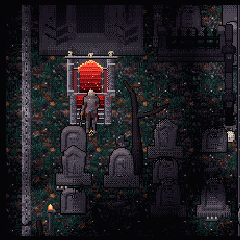
Under the scroll that opens the game, at the panel where Wick lies in the dark, the rubricator’s red ink reads Hic qui infra est ei loquitur: here the one who is below speaks to him. He has not stopped since.
What he is, on the surface
He is a voice. The captions tag him THE ONE BELOW, in gold ink, with an ember glyph. When he speaks, the window in the status panel where a speaker’s face would show goes black and embers rise in it. A single organ note sounds under every line he says. In the fire he is a pair of eyes. At one moment in the game, and one only, he is a hand.
He is never shown. Nothing in this book will show him either.
Open your eyes.
How he speaks
His voice has rules, and the rules are clues. Learn them early.
- He speaks to Wick, always, as “you”. Never “he” for Wick, never to the audience. He calls him Wick. Never “my lord”.
- He is serious. No jokes, no sarcasm, no teasing, no sulking. His weight is in the pauses.
- He is sparing. Most of his lines are under a dozen words.
- He never laughs. Not in the title, not at a death, not in any ending.
- He never lies. What he will not tell, he withholds: he is cut off, or he says less.
- He is ancient, not archaic. No thee and thou. Verse belongs to Wick; plain prose is his.
His words are graves, candles, houses, seats, hands, the price, the stone, the first. He does not talk about souls, fate or destiny. He is plain about the surface of the story (names, deeds, the six houses) and silent about himself.
What he does
He raises Wick. He offered the strength to pull the six houses down, and Wick took it before the price was named.
He brings him back. Every time Wick dies, the voice below returns him to the last crypt he opened. He calls it what it is: a vow. He counts.
Three times I have brought you back.
Ten. I will bring you back until it is finished, or until you refuse.
He tells Wick the truth about the world. Who bought him. Who killed him. What each house takes. What the candles are. He narrates the facts the story stands on, and he states them plainly so that nobody can miss them.
Then the heads of those six houses killed you on a stone. An offering.
He counsels, rarely. When a death teaches something, his remark names what killed Wick. He observes; he does not instruct.
He falls where his shadow falls. It was on you.
He arranges things. He sets the Marquis Andrevel in Wick’s path, and says so. He keeps a few for company.
You are not the first. This is the Marquis Andrevel. They made him a lord and killed him, before you. I kept him.
The argument Wick never loses
From his first mark on, Wick answers the god. He answers in verse. He answers with his pride. And every answer refuses to hear what the god just said. He wins every exchange, and he is losing the argument the whole game.
| The god says | Wick answers |
|---|---|
| “The earth did not let you go, Wick. I took you out of it.” | “An errand boy of earth, then. Still: I rose.” |
| “Seven lights. The men who founded the houses, made saints. Watch the glass. It will change.” | “Let it. Glass breaks.” |
| “Not her. Your hand stopped, and you do not know why. I do.” | “My hand is mine. It stops when I say stop.” |
| “Six heads put knives in you on a stone. He paid for you, and he held the door for them.” | “He taught me doors are opened, never held. Pour.” |
| “His last evening. He has had his armour polished, as for a feast. He is waiting for you.” | “Let him wait in steel. It has never saved a man from me.” |
| “A gift from below. The Earl’s dead will march for you now. You did not ask for them.” | “Asked or not. They march for me.” |
When the two disagree, the god is telling the truth and Wick is telling you who he is. The pleasure of the story is hearing both at once. A good test of any line Wick says: could a proud man say this and hear nothing?
Sealed · After the first houseAfter the first house: the saintsBreak the seal to read
Last month they spat at his gibbets. Tonight they kneel to his face. You made him a saint.
Priests will gild a butcher. Let them kneel to paint.
He asked you for a sword, and you gave him the stocks. A seat below will wait for him, and wait.
Let it wait. So does he.
On the path of mercy his temper is grave disappointment and foreboding, never contempt.
It is not mercy. It will do what mercy does.
Sealed · Mid-gameMid-game: what he protectsBreak the seal to read
Watch what the god’s counsel and his interventions guard. It is not Wick. He keeps Wick unread: he never explains the plot beneath, and the one book that would, Wick carries unopened. He keeps Wick unled: when a friend begins to walk at Wick’s back, the god takes the friend. He keeps the conditions of a rite.
You carry it. You have not read it.
His hand. My will. You will understand, or you will not.
He is also honest about himself, once, unasked, when a hanged woman gives Wick a gift.
Her gift is freely given. I have never given anything freely.
Nor I. We understand each other.
And when Wick cheats one of the masters the god keeps in the Wastes, the master is the god’s, and he says only two words.
Mine now.
On the road
Out in the Wastes the god speaks a little liturgy of the road. The roads were built for the tithe carts and the levy, and he knows what they cost.
The road. Every mile of it was paid for in the dead.
Every road out here ends at a gallows or a grave.
The living sleep. The dead keep watch.
Sealed · The endingThe confession, earned by failureBreak the seal to read
In the Wastes, and only there, the god’s few sentences about himself are earned by Wick’s failures: by deaths and retreats out on the roads. Fail enough and the fragments come, one at a time, to Wick.
I had a mother. She washed clothes at a river. I remember the river better than her face.
They raised me up before they struck me down. A man with nothing cannot be wronged. You must give him something first.
They killed me in a field, on a stone. There were no churches yet. There were six men who wanted to be more than men.
I came back, as you did. I killed all six. They thanked me, and I did not understand.
When I understood, there was nowhere to walk to. So I went down, and sat, and the six knelt to me. Since then I have been alone.
The first door shut on me was blue. I have not seen blue since.
I keep a few, for company. None of them lasts.
It is quiet where I sit. It has been quiet a long time.
Put the fragments next to Wick’s life and they rhyme line for line: a mother at a river, a raising before the fall, six men, a stone, the thanks. A player who earns none of them still hears the truth at the end, plainly, on the critical path.
Sealed · The endingHis name, and what he wantsBreak the seal to read
At the World, the last room, he says it once.
The first to stand here stood in a field. There was no room yet. I know, because it was I.
They call me the Stone. I was the man on it.
Every one of them knelt to me. I have waited for one who would not.
Then you have waited badly. I kneel to no one. Not even to refuse.
He was the first offering, and he Took. Before there were churches, six men who wanted to be more than men raised a man of no house, wronged him, and killed him on a stone in a field. He came back and killed all six, and they thanked him. When he understood, he went down and sat, and the six knelt, and the first seats below were his to give. The church was founded on his grave. Its rose window has seven lights: six founders with faces, and a seventh of clear glass, never leaded, “for the founder whose name was lost”. The church’s first saint is the man it killed, and it does not paint him.
The houses’ rite-book calls the power under the seats the Stone: the altar in the field, the slab under every triangle, the thing every seat rests on. Every offering before Wick knelt, or walked away. What the god has waited for, round after round, is a peer: one who will not kneel.
The endings each end on him, or without him. Refuse it, and he lets Wick go for good:
Andrevel refused with six houses standing. A spoiled offering is kept. You refuse with the work done, or undone by your own hand. There is nothing left to keep you for. Go. I will not bring you back again.
Take the seat, and his last word is the intro’s last word.
Sit.
No laugh. The hall is very quiet.
For streamers
- He cannot be skipped by accident. His lines are paced with silence around them; let them breathe. Locked conversations move on with the interact button and skip on a hold.
- His death remarks change. The first death of a kind plays in full; later ones are cut short. The remark names the move that killed you. Read it to your chat: it is the lesson.
- He never repeats himself within a minute or two. If a line is asked for again too soon, you get the caption without the voice.
- Watch the panel’s window. Embers instead of a face means the god is speaking, even when the caption is small.