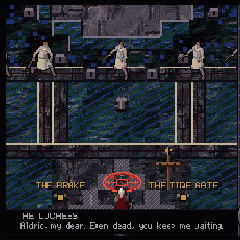
A great house is not a dungeon with a boss at the end. It is a siege in stages, and every stage teaches the rule that the last one tests. By the time Wick climbs into the rite chamber, a player who watched the house’s public life already knows how to beat its head.
A house, step by step
- Scout the ward. Walk its villages and its roads. See the grip: what this house takes, and from whom.
- Witness the mask. Every house keeps its grip with a public ceremony: the muster, the foundling procession, silent vespers, the foundation stone, the odds board hung, the feast. Watch it. It is the lesson.
- Walk the procession. Each house’s procession traces a figure through its ward. Shadow it, and Wick walks the figure himself.
- Break the grip. End, free or bend a lieutenant. Each one you break removes or changes one element of the rite.
- Climb to the rite. The head fights at full force, from a circle with a gap left in it on purpose.
- The asking. Beaten, the head kneels and asks, aloud.
- The blow, or not. Hold the strike, or lead them away.
- The aftermath. A canonisation in the head’s village, or the walk down to the pillory and a trial.
- The priest’s visit. Father Fulcran comes down the visitors’ stair with one question and one gift.
No door of yours would open to my name. So I came up through your floor.
The rules every rite keeps
- The grip is the lock. Each house’s machinery of oppression is its rite’s puzzle: the levy line, the tide, the silence, the machine, the odds, the feast. You beat the head with the house’s own engine.
- Puzzle into the fight. The approach teaches the rule the rite tests.
- Every head leaves a gap. Each rite has a flaw left on purpose, and the flaw is the way in. Wick reads it as weakness.
- Hits land through openings, not through a health bar. A head takes three or four real openings, never forty sword swings. Each opening is shown once, safely, before it is needed.
- The base kit always suffices. Sword, spin, beam, burst, Bend Will, feeding and the room itself win every rite. Gifts and people open a second way, never the only one.
- No free safety. No verb negates damage. Every power has a room where it fails.
- One sentence. You can tell a friend how you beat each head in one sentence. If it takes two, it is two rites.
The one sentences
| House | How it is won, in one sentence |
|---|---|
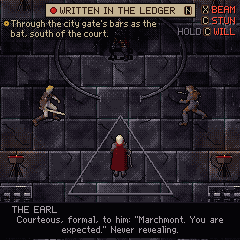
| The Tower | “You bait the Earl’s reach and slip through the gap in his circle between lightning strikes.” |
| The Wheel | “He sees your every move, so you make someone else land the blow.” |
| The Empress | “Her wards must fall first, by the blade, by her water or on their knees; then you brake the great wheel she left unchained and wade to her while the tide stands still.” |
| The Sun | “You starve the King’s feast until no one is left to toast him.” |
| The High Priestess | “In the dark you go to the bell that keeps the vespers beat, and you move and strike only on its stroke.” |
| The Magician | “You crush his twins in his own moving house, then set the capstans so the machine brings his gallery stair down to you.” |
The choice
Beaten, the head kneels and asks for the blow. The asking always shows its words on screen, whatever the subtitle setting.
| Hold the strike: the blow | Lead them away, or walk off: the spare | |
|---|---|---|
| The head | dies, and thanks him | lives, ruined, led through the household to the pillory |
| Wick gains | the house’s gift from below | a weapon class of his own (from four of the six houses) |
| The villages | freed, and soon kneeling at a new shrine | freed, and the council lights its lamps in the ward |
| The rose window | the house’s light is re-leaded with a new face | the house’s light goes dark |
| The candle | gold wax, a still flame, a halo | out, in a thread of smoke |
| The haven | that house’s river thins | that house’s river runs dry |
| Later | the ruined head is still alive, and will come looking for him |
Only heads of house (and one other, late) have the beaten state and the held blow. Lieutenants yield instead: the strike kills them, the beam takes them as a witness, who testifies at the head’s trial. Everyone else dies normally, with no prompt, so ordinary fights stay fast.
Two heads always die
The first two heads can never be spared: the Earl Marshal of the Tower and the Lord President of the Magician’s house. If you try (lead them, or walk away), Wick overrides you. The game’s rule is that your choices reach Wick as the voice below’s influence, and he feels them. With these two, he refuses it, and says so to the god before the blow lands.
I know you wanted him to live. You pull; I felt it in the hand.
Not this one. The first goes down, and I say so.
He laid the street I was dragged down. He goes. My decision, not yours.
Every player gets the first two gifts. Every other head is yours to judge.
Wick feels your hand
After every other head’s fate, Wick turns to the god with one short line about whose hand it was. He never quite admits it was yours.
Your hand eased mine, and she lives. Let her call it mercy. I know better.
A king, and I felt you lean. He is down. The weight was yours and mine.
The aftermath
Killed: a canonisation in the head’s village. The shrine’s carving is whitewashed and the dead head’s face painted over it in a halo; collectors stand where the soldiers stood; the village kneels.
Spared: the walk down through the household, the head under Wick’s hand, the villages lining the road to the pillory. Then the council tries them. The first trial you cause is a full scene; later ones are stills. Each verdict dissolves the grip by decree.
A seat below stays empty. The city decides now. It will not stop with him.
Either way, Father Fulcran comes down the visitors’ stair into the haven afterward, kindly, with a question he never answers himself.
The count
There is no clock; the story advances by how many houses have fallen, killed or spared.
| When | What happens |
|---|---|
| After the first house | the priest hands Wick the charity’s accounts |
| After the third house | the King’s herald comes down to the gutter: the summons |
| After the King | the world opens; the great canonisation waits in the church |
| With all six ended | the Bishop’s rite, and then the stair under the orphanage |
Sealed · After the first houseWhat each kill makesBreak the seal to read
Every head Wick kills goes below to a seat, and comes back above as a saint. The church canonises them within days; their faces are leaded into the rose window; their grip on the freed becomes faith. The halo, the church will say, is kinder than the rope. The gift is the toll. The thanks is the receipt. Sparing is the only way to deny a head the seat it paid for.
He thanked you. Listen, next time they thank you.
Sealed · Mid-gameThe heads come backBreak the seal to read
After the great canonisation, every surviving head, from the seat of a house still standing or from the pillory, comes to the gutter to force Wick into combat and be killed. Beat them again and they go back to the stocks. Give the blow and they become saints after all. If the Tower fell by the blow and its Marshal lived, the Marshal hunts Wick for his lord’s death: the one sincere vengeance in the game, a mirror.
(a net drops off the tavern roof onto the nearest of them) Hunter’s law. Nobody hunts alone.
Sealed · The endingThe rite that is not a houseBreak the seal to read
After the great canonisation, the Bishop stays at the altar. His rite is required, and it is the only head-like fight where nobody thanks Wick and no candle goes out. He is armoured by the saints Wick made: every re-leaded light in the rose window throws a shaft on him and turns blows, and the beam breaks a light out of the glass. Every head Wick spared can be brought from the pillory to testify under a light and put it out for good. It is the one fight where the whole run’s choices are the puzzle. Kill path: “You face your own saints.” Spare path: “The men you spared testify him naked.”